General information, not individual medical advice. Speak to a qualified healthcare professional about your own needs.
Form: identify the ingredient.
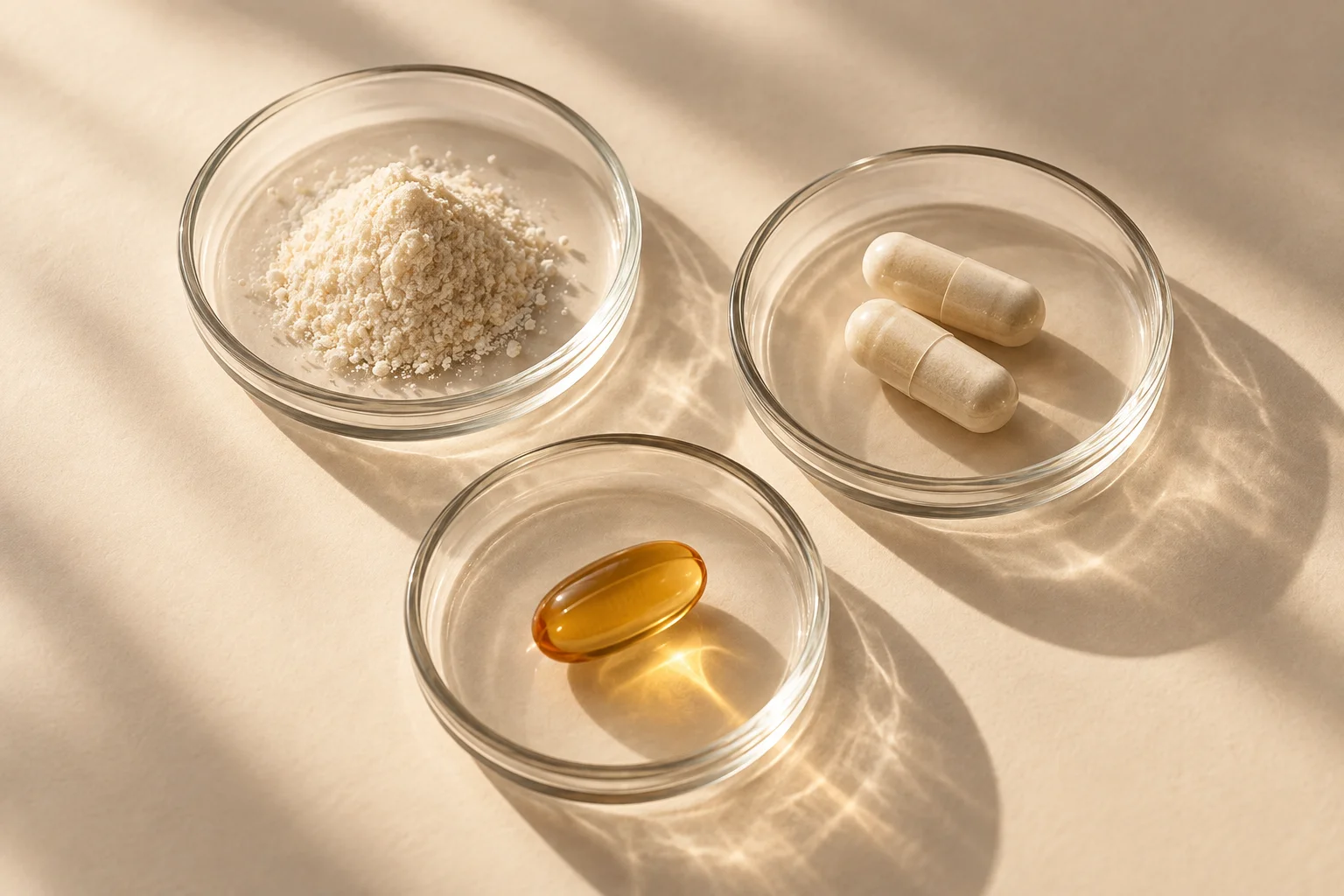
Capsules, powders and liquids describe a product’s format. The form of an ingredient is a separate detail. A format tells you how a supplement is presented; it does not, on its own, explain what is in it or establish how well it works.
We look for the specific ingredient names in the full formula, then the manufacturer’s explanation of those choices. Claims about absorption or an advanced delivery system need supporting evidence. A technical-sounding name is not a reason to assume one product is superior to another. The explanation has to be specific to the claim.
Sources: NIH ODS: Dietary supplements: what you need to know ↗
Dose: compare like with like.
Compare amounts using the same units and the same serving basis. The amount per capsule, per scoop and per stated serving may be different. For a hypothetical two-capsule serving, comparing its total with another product’s single-capsule amount would distort the comparison.
Record the number of servings as well as the pack size. Sixty capsules do not necessarily mean sixty servings. These are basic product facts, but they are essential to understanding a formula. We want them clearly stated, without making the customer reconstruct the information from several parts of a label.
Sources: NIH ODS: Dietary supplements: what you need to know ↗
Purpose: connect the formula to the evidence.
A formulation needs a clear reason to exist. That means a defined purpose, a rationale for the ingredients and amounts, and evidence relevant to the claims being made. Adding more ingredients does not remove the need to explain each one.
NCCIH notes that products sold to consumers can differ from those used in studies. Research on an ingredient is therefore not automatically evidence for every finished product containing it. We distinguish evidence about an ingredient from research on a complete formulation when assessing the support for a product’s claims.
Assess the whole formulation.
Our selection starts with the complete ingredient list, the stated serving and the supporting documentation. From there, we assess the rationale for the product and the clarity of the manufacturer’s information. Form, dose and purpose belong in the same assessment.
Higher amounts are not automatically better. Supplements can cause adverse effects or interact with medicines; a qualified healthcare professional should assess personal suitability. This guide explains product information, not a dosing plan. Sources describe US supplements and labelling; local requirements vary.
Sources: NIH ODS: Dietary supplements: what you need to know ↗ · NCCIH: Using dietary supplements wisely ↗
Read the sources
Many sources describe US products and labelling. Requirements and availability differ by country, including across the GCC.